

What Buyers Need to Know When BESS Proposals Differ by Millions
.
Battery Energy Storage Systems are scaling rapidly, but proposal transparency, lifecycle economics, and buyer education still lag.
Recently, I had a meeting with the head of business development for a renewable energy contractor we’ve been speaking with about integrating one of our Battery Energy Storage Systems into an upcoming project.
Smart guy. Experienced in renewables. Clearly understands solar, EPC processes, and the commercial energy landscape.
But during the conversation, something became very clear.
While he understood what battery energy storage systems do, there were gaps in understanding what to actually look for in a BESS proposal.
And honestly, that’s not unusual.
Renewable energy has been around long enough that many parts of the industry are well understood. Solar, distributed generation, EPC execution, interconnection, and project finance all have a level of maturity behind them.
But BESS, especially at today’s scale, sophistication, and deployment volume, is still relatively new territory for many organizations.
The market is moving fast. Faster than education in many cases.
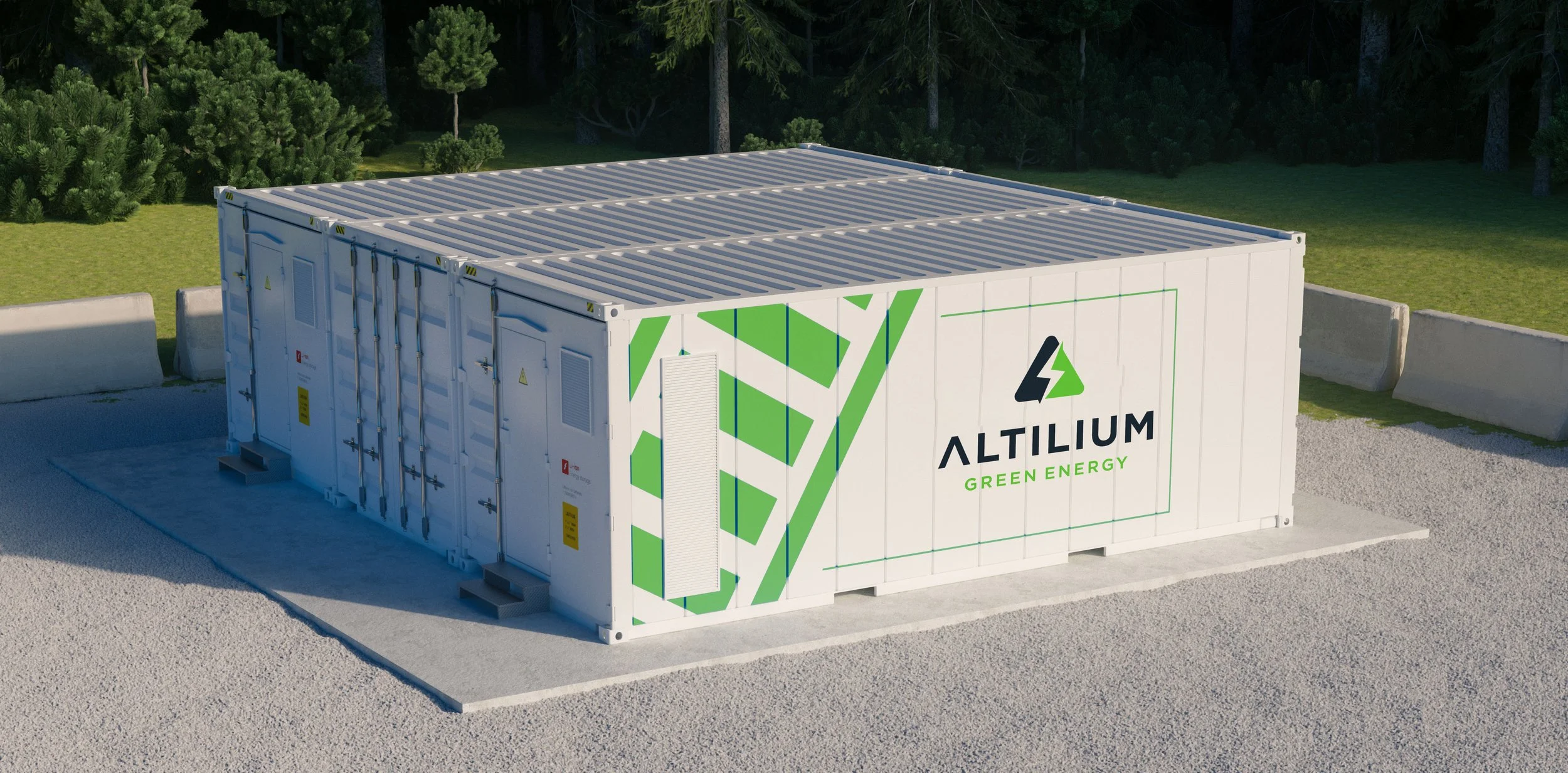
At Altilium, we don’t see that as a weakness or a criticism of buyers entering the space. In fact, educating clients and partners is one of the parts of our work we enjoy most. If our customers become more informed buyers, the industry gets stronger, projects perform better, and everyone wins.
That’s the kind of partnership we believe in.
When Pricing Doesn’t Make Sense, Ask Why
During our discussion, the contractor shared that they had received four BESS proposals, including ours.
The pricing ranged from roughly $89,000/kWh to $207,000/kWh.
Let that sink in for a minute.
Even accounting for differences in brand, buying power, project location, integration scope, equipment selection, and supporting infrastructure, that is a massive spread for systems that were supposedly designed to meet the same project specifications.
Naturally, it raises some important questions.
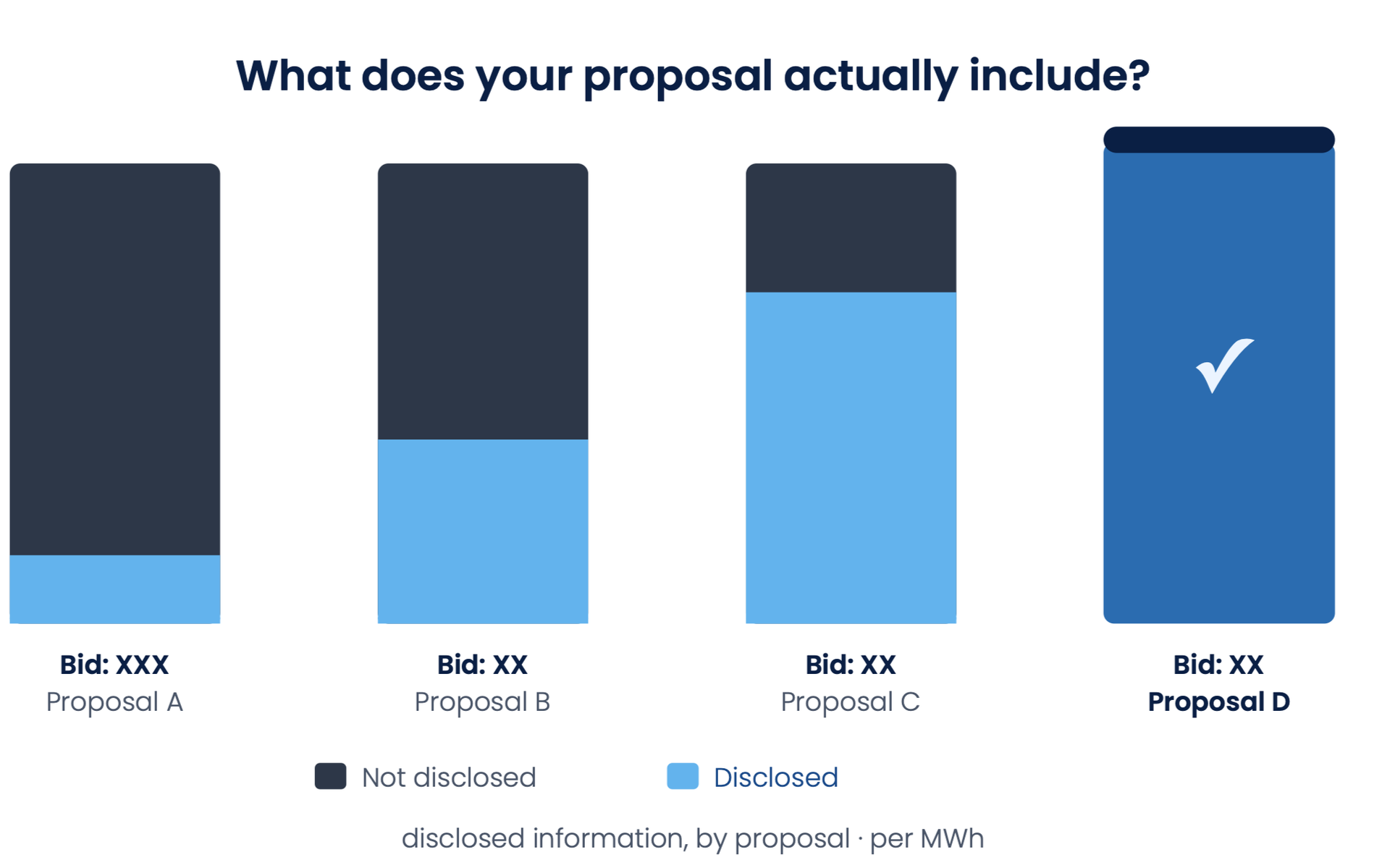
What is each company actually including?
What assumptions are built into the pricing?
What performance guarantees exist?
Are these systems truly comparable?
And maybe most importantly, does the buyer have enough information to make a confident decision?
Under strict confidentiality, the prospective client anonymized the competing proposals and shared them with us so we could help build an apples-to-apples comparison matrix.
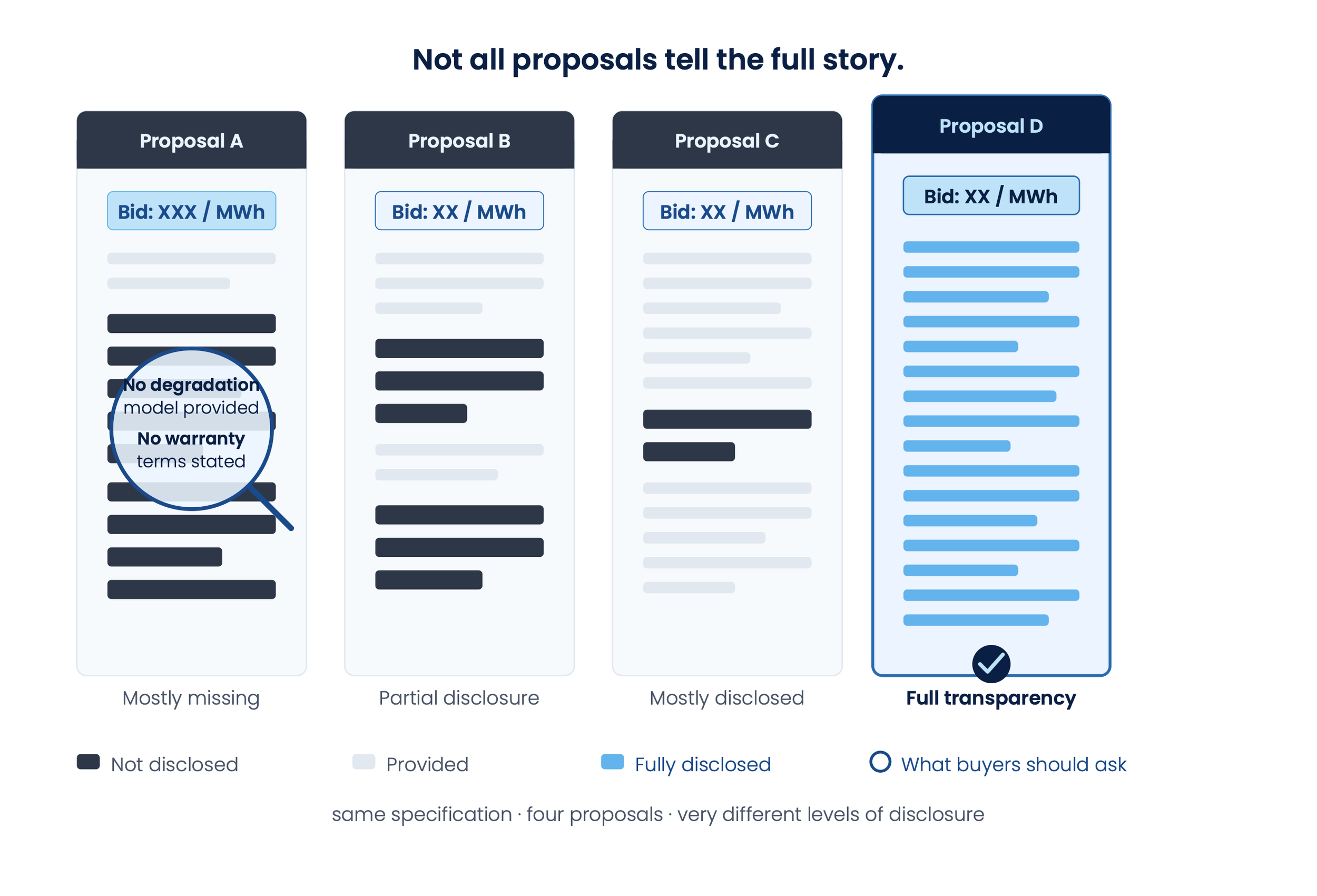
What we found was eye-opening.
Every proposal approached pricing differently, and that’s okay. Different companies have different business models, supply chains, engineering philosophies, and risk tolerances. Healthy competition and market differentiation are good for the industry.
But nearly every proposal was missing critical information required for the customer to make a fully informed decision.
Not marketing information.
Not brochure-level claims.
Actual operational, performance, safety, and lifecycle information.
And that’s where problems begin.
The Comparison Matrix Wasn’t Just About Finding Gaps
As we began building the comparison matrix, the goal was not simply to show the customer where other proposals were incomplete.
That would have been easy.
The more important goal was to help explain why those gaps mattered.
Because a missing detail in a BESS proposal is not always obvious on the surface. Sometimes it looks like a small omission. Sometimes it is buried in technical language. Sometimes it is hidden behind a broad assumption.
But those missing details can materially impact system performance, operational expectations, safety considerations, maintenance planning, augmentation requirements, warranty coverage, and long-term project economics.
So the comparison matrix became more than a pricing tool.
It became an education tool.
It helped identify the questions buyers should be asking every BESS provider during the evaluation process.
Questions like:
What assumptions were made around degradation?
How is augmentation being modeled, forecasted and why?
What happens if actual usage differs from modeled assumptions?
What safety systems and certifications are included?
How are warranties structured, and what exclusions exist?
What operational data will the customer have visibility into over time?
In many ways, this became less about comparing vendors and more about helping the customer build a framework for making a truly informed decision.
And honestly, that’s something our industry needs more of.
The Lowest Upfront Price Isn’t Always the Lowest Long-Term Cost

One proposal specifically referenced “future augmentation” as part of the system strategy.
On paper, that may sound reasonable.
And to be fair, augmentation can absolutely be part of a legitimate long-term system design strategy depending on the customer’s goals, operating profile, and financial priorities.
The concern was not the concept itself.
The concern was the lack of detail surrounding it.
There was no clear explanation of what augmentation meant, when it would occur, how often it would be required, what costs would be associated with it, or how it would impact long-term system economics and performance.
That’s where transparency matters.
Without clarity, lower upfront pricing can sometimes shift costs into later phases of the project lifecycle, making it difficult for customers to fully understand the true economics of the system they’re purchasing.
We understand every client’s financial objectives, operational priorities, and project constraints are different. In some cases, minimizing upfront investment is absolutely the right decision.
At Altilium, we encourage customers to look beyond just Day 1 CapEx and also consider long-term factors like lifecycle performance, augmentation strategy, total energy delivered, and Levelized Cost of Storage so they fully understand the long-term operational and economic implications of the system they’re buying.
That does not mean every customer should prioritize the exact same metric.
Some projects optimize for upfront affordability.
Some optimize for operational flexibility.
Some prioritize long-term energy economics.
Others may focus on total energy throughput, resilience, financing structures, or deployment speed.
All of those can be valid priorities.
The important thing is ensuring customers understand the tradeoffs associated with each approach before making a decision.
A simple analogy most people can relate to is buying a car.
We’ve all sat with a dealer who asks, “What monthly payment are you comfortable with?”
Sure, they can lower the payment.
But depending on how the financing is structured, that can sometimes mean extending the loan term or increasing the total amount paid over time.
That does not automatically make it the wrong decision.
For some buyers, lower monthly payments may be the best fit for their situation.
The key is understanding the full financial picture and making an informed decision based on your priorities.
Battery storage projects are no different.
Missing Information Creates Hidden Risk
Another major concern was how much critical information was simply absent from several proposals.
Performance assumptions were vague.
Safety details were limited or nonexistent.
System degradation projections were unclear.
Warranty structures lacked specificity.
Operational expectations were missing.
Now imagine trying to make an important purchase in your personal life with only half the information.
Imagine buying a home based only on beautiful kitchen photos, only to later discover major structural or foundation issues that were never disclosed upfront.
At first glance, it may look like a fantastic deal.
Until the missing information changes the entire picture.
That’s exactly why transparency matters in BESS procurement.
Customers should not need to be battery experts to understand what they are buying.
The responsibility should also fall on solution providers to clearly explain system assumptions, limitations, operating strategies, safety considerations, and long-term expectations.
The Industry Needs More Standardization — Not More Complexity
To be clear, this is not about criticizing competitors.
Companies are free to structure proposals, pricing models, and solutions however they choose. Innovation and market differentiation are healthy for the industry.
But battery storage is no longer niche technology.
As deployments scale and more organizations enter the market, some level of proposal standardization and disclosure best practices becomes increasingly important.
Not excessive regulation. Not bureaucratic red tape.
Just enough consistency to help customers make informed decisions, properly compare systems, understand lifecycle assumptions, evaluate safety considerations, and avoid unexpected surprises later in the project lifecycle.
Because right now, many buyers are evaluating major energy infrastructure projects without having a complete framework for what questions should even be asked.
That is not a criticism of buyers.
It is simply a sign of a rapidly evolving industry.
And as an industry, we have a responsibility to help close that education gap.
Transparency Builds Stronger Projects
One of the things we value most at Altilium is transparency.
If there is a tradeoff, we will explain it.
If there are multiple viable approaches, we will walk through the pros and cons of each.
If a customer’s priorities point toward a different design philosophy than our initial recommendation, we will have that conversation openly.
Because long-term partnerships are built on trust, not just transactions.
Battery Energy Storage Systems are becoming foundational infrastructure for the future of energy. The decisions being made today will impact project economics, reliability, and operational success for years to come.
Our responsibility as an industry is not simply to sell systems.
It is to help customers understand them.
At Altilium, we believe informed customers make better long-term partners, better investment decisions, and ultimately build more successful energy projects.
If you are evaluating a BESS project and would like a second set of eyes on a proposal, we are always happy to have a conversation.
Even if the outcome is simply helping you ask better questions, that is a win for the industry.
Preparing an RFP or comparing BESS proposals? Reach out. We can help you cut through the headline price, spot the hidden cost drivers, and make decisions that hold up over the life of the asset.